
What Lincoln Saw This Week
September is over. The ribbons come down, the awareness graphics stop showing up in your feed, and by October the algorithm has already moved on to something else.
I want to talk about what happens next, and about a week that tested the answer for me directly.
Physical illness comes with a built-in playbook. Someone gets a cancer diagnosis, and within days there's a meal train, a card, a "just tell me what you need." Nobody has to be taught what to do. Mental illness doesn't come with that same playbook. People who would show up without blinking for a broken bone go quiet for a broken mind, not because they don't care, but because they're afraid of saying the wrong thing, or making it worse, or intruding on something too private to touch. So they say nothing at all, and the family in the middle of it, the one that could actually use the casserole, gets left in the silence instead.
I wear a semicolon on my wrist for exactly this reason. I chose a visible spot on purpose. For people who don't know what it means, it's an opening, a chance to ask, and a chance for me to talk about something most people are too afraid to bring up on their own. For people who already know, it's immediate. No explaining required. Just a quiet acknowledgment between us that I'm an advocate, that I'm aware, and that whatever they're carrying, I'm someone safe to carry it near.
This week, I got to test that idea in a room full of strangers.
I flew to Washington, DC to meet my new team in person for the first time: my boss, my boss's boss, my peers, all in one room together for the first time. We went around the table and talked about who we are. We talked about culture, trust, and the kind of accountability that only works when people actually know each other. When it was my turn, I shared my story at a high level: some of what I've worked through with mental health, and the book I wrote about it. I didn't go deep. I didn't need to.
What happened next is the part I keep coming back to. One of my new colleagues, unprompted, asked if she could learn more about being transgender and using the right terms. She didn't know much. She said so plainly. And she asked anyway, in a room where it would have been easier to stay quiet.
That's showing up. Not having the right words. Being curious enough, and brave enough, to ask for them.
We also talked that day about how people carry things into work that have nothing to do with work: a rough night, a kid who's struggling, a body that's dysregulated before the meeting even starts. I brought up social styles, a framework for understanding how people are wired to operate, especially under stress, and why that matters for how we lead. In a lean, fast-paced environment, we don't always have the luxury of slowing down. But tools like this help us learn ourselves and each other faster, so we can actually show up for our people, especially the junior folks still finding their footing. That's how you build a culture of partnership instead of just output. It's how people learn they're valued, not just useful.
I'm an expressive driver. Under real stress, I go one of two ways: even more expressive, if that's possible, or I flex into the amiable quadrant, quiet, because I'm afraid of what I'll say and the impact it might have on others. Either way, my silence is just as loud as my expressiveness, if you know how to read it.
That's true for the people you love too. The ones going quiet aren't always fine. Sometimes quiet is the loudest thing they're telling you.
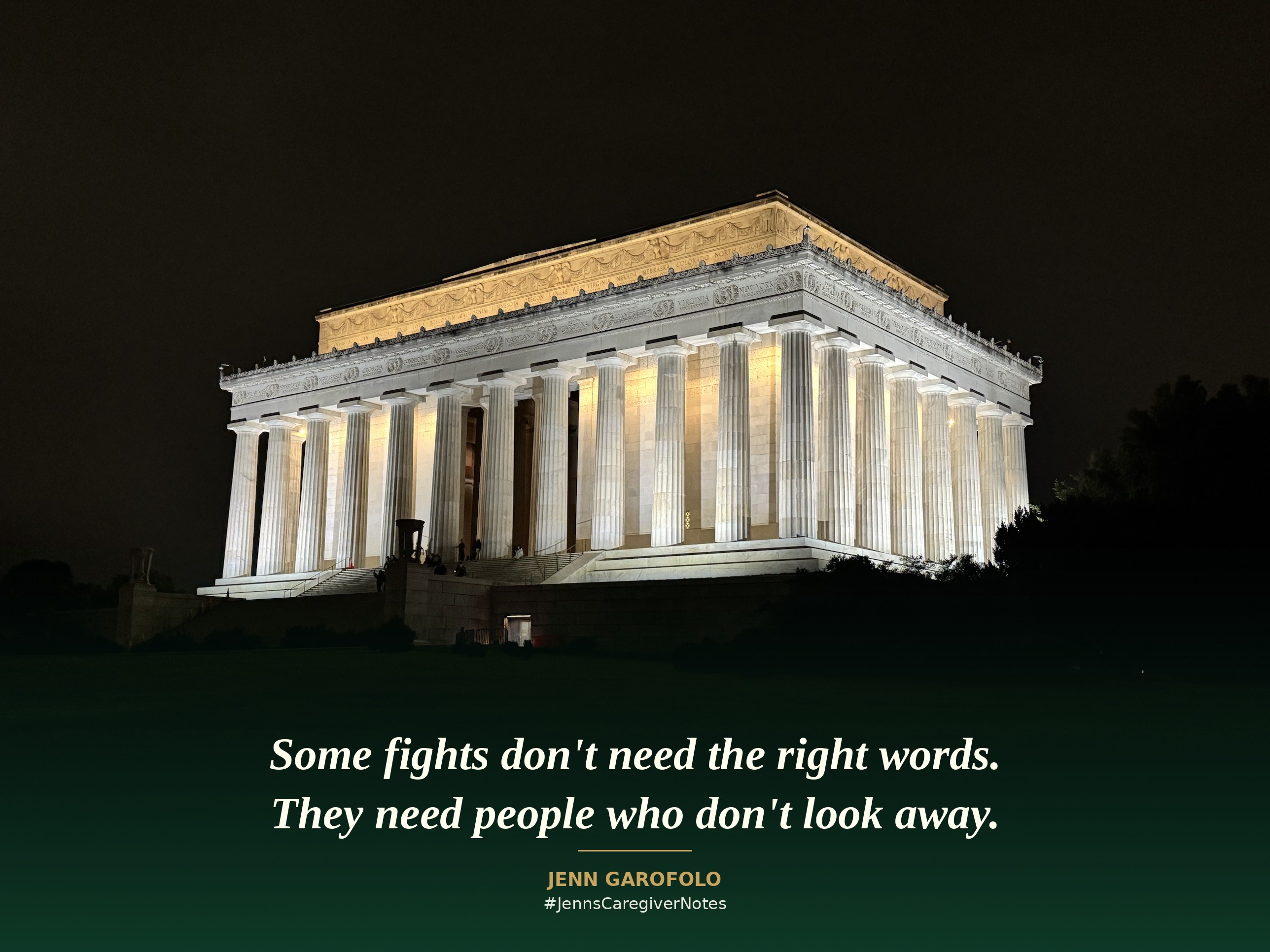
That night, a few of us walked over to see the monuments. I stood in front of Lincoln, lit up against the dark, the way he has stood for over a century for the idea that the law should protect everyone, not just the people already in power. Two days later, the Department of Education formally rescinded Title IX protections for sexual orientation and gender identity, reverting to a narrower rule that leaves transgender students without that federal protection. And the 988 crisis line's specialized service for LGBTQIA+ youth, cut more than a year ago, still hasn't come back, despite promises that it would.
I stood at that monument thinking about a colleague brave enough to ask a question. About a country still fighting over whether my son's identity is something to protect or something to legislate away. About how showing up for one person and fighting for a whole community draw from the exact same well.
Neither one requires the right words. Both require people who don't look away.
The hashtags fade on October 1. The need doesn't. Neither does the fight.
💚 Jenn
If you or someone you love is struggling, the 988 Suicide and Crisis Lifeline is available by call or text, 24 hours a day. The Trevor Project also offers LGBTQIA+ youth specific crisis support, by phone at 1-866-488-7386 or by texting START to 678-678.
💚 Jenn
Get new essays in your inbox.
New posts, book news, and updates, delivered to your inbox.