
Winter Night
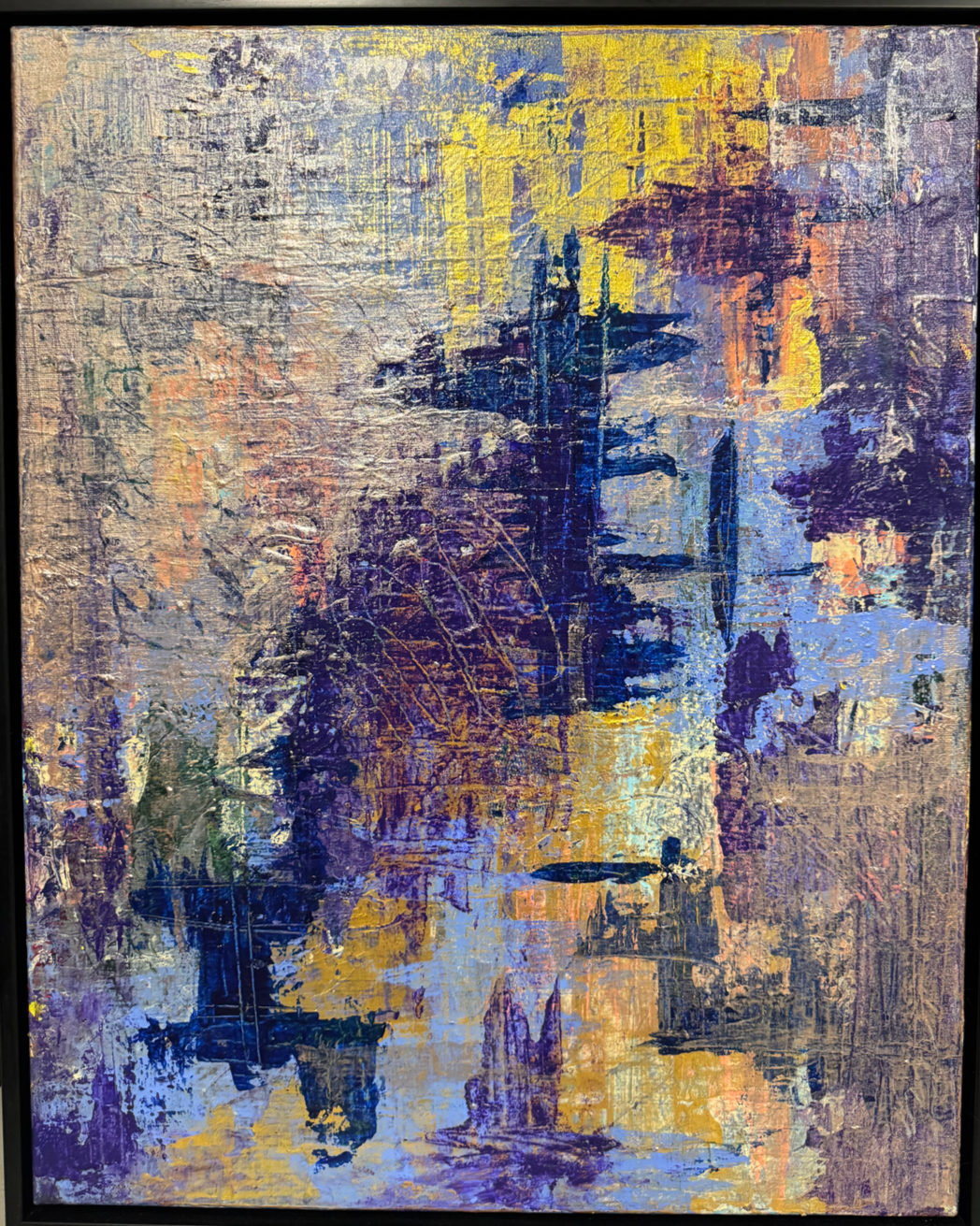
This spring I bought a painting at an art show. I could not stop looking at it.
It is mostly dark. Deep blue, violet, a city breaking apart into its own reflection. But there is gold in it, pushing up from underneath, the way light does at the very end of a winter day. The title is written on the back in blue ink. Noche de Invierno. Winter Night.
The artist is Ed Rocha (@edwardrochaart). The show was called Ecos y Reflejos, Echoes and Reflections. Ed does not paint the way I assumed painters paint. He never plans a canvas. He paints from what he is feeling and seeing in the moment, and then he does it again, and again. "I don't plan each painting. I layer, scrape, and wipe paint in layers, until I see something come together." Some of his pieces hold twenty-five layers. Each layer is its own emotion, its own moment, painted and then mostly buried under the next.
As we moved through the show, Ed came around and told people, one by one, how he wanted them to look at his work. Stand with a painting. Really look at it. Then close your eyes, and notice the very first thing that surfaces. A memory. An image. Whatever comes.
When I did that with Winter Night, the first thing I saw was the swirl. There is one right in the center of the canvas. If you look closely it almost looks like a tornado, everything pulling and spinning toward the middle. I know that feeling in my body. The weeks where the world moves too fast and too heavy, where everything is spinning at once and you cannot find the floor. We have been through the hardest stretch of our family's life, and for a long time the swirl was all I could see.
So I stayed with the question the painting was asking me. When everything is spinning, how do you find the center again? How do you change what you are looking at when life feels too heavy to lift?
Here is the only answer I have. You do not make the storm stop. You change where you put your eyes. Ed's instruction was the whole thing in miniature. Look hard. Close your eyes. Then open them and look again, on purpose, at what is actually there. Because the longer I looked at Winter Night, the more I saw past the swirl to the light coming up underneath it. The gold was not sitting on top. It was working its way out from below. And I understood that all those buried layers, every hard one, were still there, still part of it, and that something was finally starting to come together over them.
That is when the painting stopped being only about the pain. A person is layered the way that canvas is layered. Twenty-five deep. You cannot understand someone by the one layer on top, and you certainly cannot understand them by the worst one. My whole book is about that. About a child's right to be seen as a whole person instead of a problem to be managed.
I have a saying I come back to. When a door closes, the Holy Spirit opens a window, but only if you are willing to climb through it and go looking for the good on the other side. That is what Winter Night means to me now. It is hanging where I will see it every day.
If you are in your own winter right now, in the middle of your own swirl, I am not going to tell you it is not dark. It might be very dark, and very fast. I am only going to tell you what the painting told me. Stop. Look again, on purpose, and longer than feels reasonable. The light is already coming up through the layers. It was there the whole time.
Jenn 💚
Get new essays in your inbox.
New posts, book news, and updates, delivered to your inbox.