
The Water Doesn't Boil Forever
September is Suicide Prevention Month, and it lands differently for our family than it might for most. This isn't a topic I encounter from a distance.
Daniel was eight years old the first time he told us he wanted to die. Eight. How does a child that young even know what that means, or what they would do about it?
We didn't have language for what was happening yet. What we had was years of showing up, advocating, asking question after question, refusing to accept "she's just strong-willed" or "he'll grow out of it" as an answer. That persistence eventually led us to a doctor who gave us a framework that changed everything: think of a struggling brain like a pot of water on a stove, always hovering just below a boil. Therapy, coping skills, all the tools a good clinical team can offer, none of it can really reach a child while that water is still boiling. The right medication is what brings the temperature down enough for a child to hear, to process, to actually use those tools. Without it, the temperature just keeps climbing.
That was Daniel. For a long stretch, nothing in his medication regimen brought the temperature down far enough. And here's something I wish someone had told me sooner: finding the right medication isn't a one-time fix. What works can stop working. We had to relearn that more than once. It was never something we solved and moved past. It was something we kept tending to.
I think about all of it a lot this month.
Here's where we are now. Daniel is doing well. He's living his life to the fullest, doing the things that make him happy. The water isn't boiling anymore. I don't say that as though the fight is over for good, mental health doesn't work that way for anyone. But I say it because I need people to hear it: it is possible to come out the other side of a crisis like this and build a life that is genuinely good.
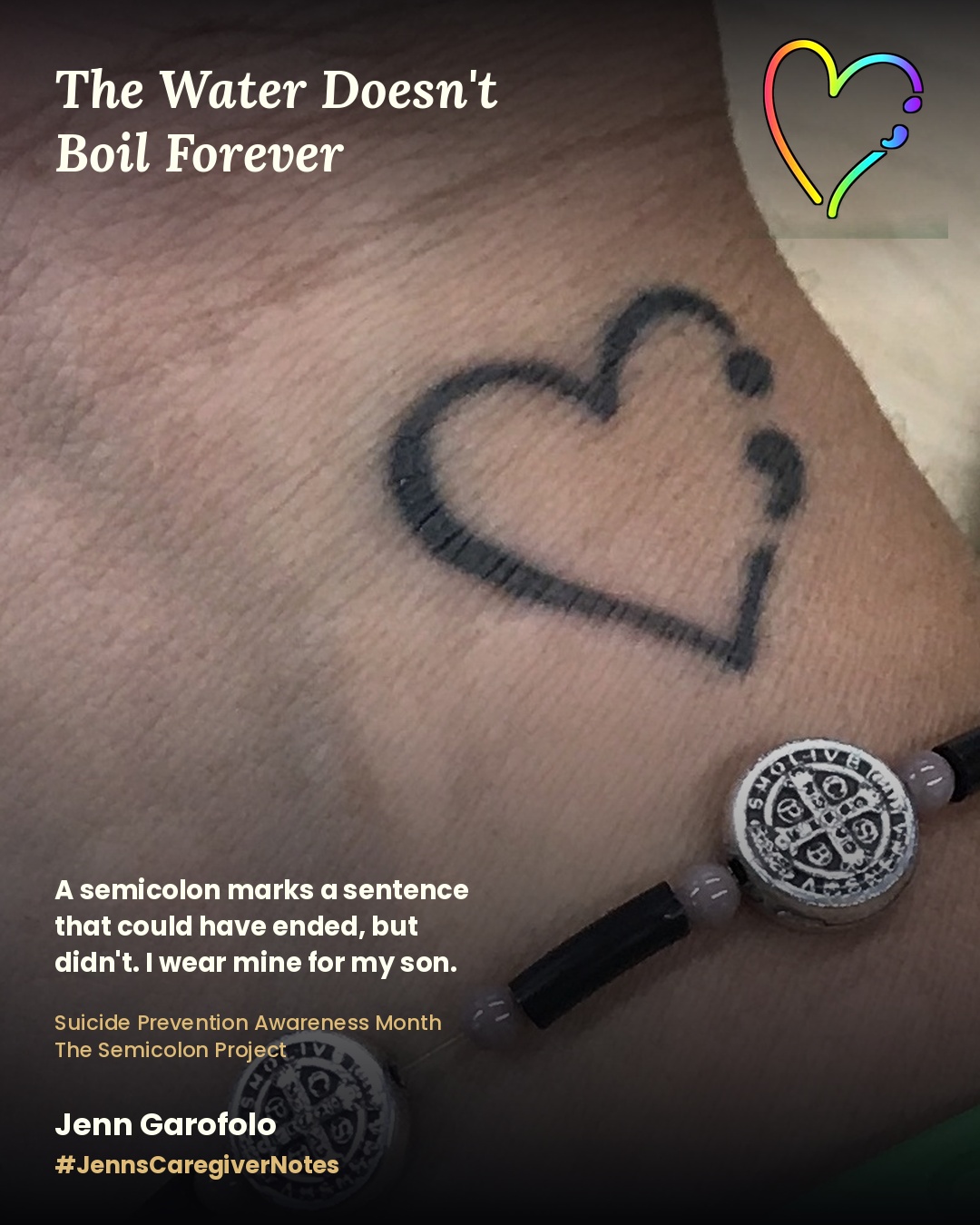
About a year after that first crisis, I got a semicolon tattoo on my wrist. A semicolon is what a writer uses when a sentence could have ended, but didn't. It's the symbol of Project Semicolon, a movement of solidarity for anyone who has battled depression, anxiety, self-harm, or suicidal ideation. I put mine somewhere people would see it, on purpose, because I wanted them to ask. Every time someone does, it's a chance to talk about suicide awareness instead of staying quiet about it.
If you are the parent of a child in crisis right now, you don't have to understand everything happening in your child's brain to keep showing up for them. You don't have to have the right words. You just have to stay reachable, and keep asking the questions until someone gives you real answers.
Some of what I wish I had known to watch for: withdrawing from people or things they used to enjoy, big changes in sleep or eating, talking about being a burden to others or feeling hopeless, sudden calm after a period of real distress, giving away belongings that matter to them. None of these mean something is definitely wrong. But they're worth paying attention to, and worth asking a direct question about.
If you or someone you love is struggling, the 988 Suicide & Crisis Lifeline is available by call or text, 24 hours a day. For LGBTQIA+ youth specifically, specialized support is available through the same line by pressing 3.
💚 Jenn
Get new essays in your inbox.
New posts, book news, and updates, delivered to your inbox.