
Be the loudest voice in the room.
There is a line in my book I keep coming back to. "You are the loudest voice in the room. Make it count. For your child. And for the families behind you, too."
I wrote it about the years I spent learning to advocate for my children, in hospital rooms and doctors' offices, and in school systems that did not always listen. Standing up for a child who cannot yet stand up for themselves, inside institutions that were not built to hear a parent. But this week the line found me somewhere I did not expect. Not in a waiting room or a meeting. On a sidewalk, and then on a stranger's front lawn.
Let me tell you what happened, and then let me tell you why it matters.
A few weeks ago I was at the park with one of my kids. We are in a season of slow, careful rebuilding, of finding the way back to the things they love after a long stretch of being unwell. The kind of unwell you cannot see from the outside. We talk a lot about mental health in our house, and about the illnesses that never show up on a face or in a photograph. That afternoon, my child was working on something in the grass and asked me to watch. A moment later they came to me quietly. Two boys they recognized were laughing and pointing.
I did not yell. I walked over and asked one simple question. Do you think it is kind to laugh at someone and point at them? That was it. We gathered our things to leave. But the boys followed, circling around on their bikes until they could see where we live. I sent my child inside and waited. I told them, calmly, that there was no reason to follow us home, and that they could go on their way.
I want to stop here, because this part matters more than the boys.
Children are not born cruel. They learn it. And right now they are learning it in a culture that has started to treat contempt as strength. When people in positions of power model cruelty toward anyone who is different, anyone marginalized, anyone carrying something hard, it gives everyone else permission. It does not stay in the headlines. It trickles down. To a park. To a doorbell camera. To a front lawn.
So let me call it what it is. This is bullying. We use softer words when children do it, and softer still when adults do, but the thing underneath is the same. Here is what I want my kids to understand: we are allowed to disagree. We do not have to like each other, or think the same way, or land in the same place. That was never the problem. The problem is choosing to be unkind about it, and then choosing it again. Whether it is two kids laughing and pointing at a park, or a grown man at his own front door, bullying is bullying. Teaching kindness means holding people accountable to it, even when it is uncomfortable.
A few days later, while I was at the hospital with my child, those same boys turned up again, this time recorded doing something they had no business doing at our home.
So my husband and I decided to do the thing we are always telling our kids to do. We went to talk it out. Adult to adult. We rang the bell, introduced ourselves, and tried to have a calm conversation about what had happened.
It did not go the way it should have. The father would not really speak to me. He told me he had heard about me, that I was "the crazy lady." He reached for mental health as an insult, which is a particular kind of irony in my house. He would only address my husband. And when I realized we were getting nowhere, I made the other half of advocacy look like what it sometimes has to be. I said it was not worth it, and I walked to the car.
Here is what I have learned, and what my book is really about. Advocacy is rarely the dramatic version you picture. It is calm. It is tired. It is showing up at a door in the middle of the hardest week, because the alternative is letting it slide. As I wrote, speak up even if your voice shakes.
And standing your ground is not the same as matching someone's ugliness. Refusing to become what you are standing against is its own kind of strength. I did not need to win that conversation. I needed to model, for my children, that we name what is wrong, and we do it without becoming cruel ourselves.
I will be honest about the part that still stings. Being called names, knowing people talk about you, that lands even on a grown woman who has done all of this work. Resilience was never the absence of hurt. If you have read my story, you know that getting stronger over time never meant it stopped hurting. It meant I chose to stand anyway.
When I was writing this book, I almost did not share all of it. There were parts, including my son Daniel's story, that I considered keeping private. And then I came back to the question that runs underneath everything I do. If not me, then who. If we do not put ourselves out there, if we do not show what it actually means to stand up for people who are different, then we leave the next family to figure it out alone. That is not allyship. Allyship is what you are willing to do when it costs you something.
Everything this past week led me here. I stood in a full room and said out loud the things I once was too afraid to say. And then I stood on a sidewalk, and a front lawn, steady, for a child who could not yet stand up for themselves.
So before you go, I want to leave you with a question instead of an answer. Think about a moment when you stayed quiet. When you saw someone being treated unkindly, someone who did not have a voice in that room, or someone coming up behind you who needed an advocate, and it would have been easier to look away. We have all had that moment. I have had plenty. What would it look like to show up differently next time? Not louder for the sake of loud, but present. Willing to say, gently and clearly, that this is not how we treat people.
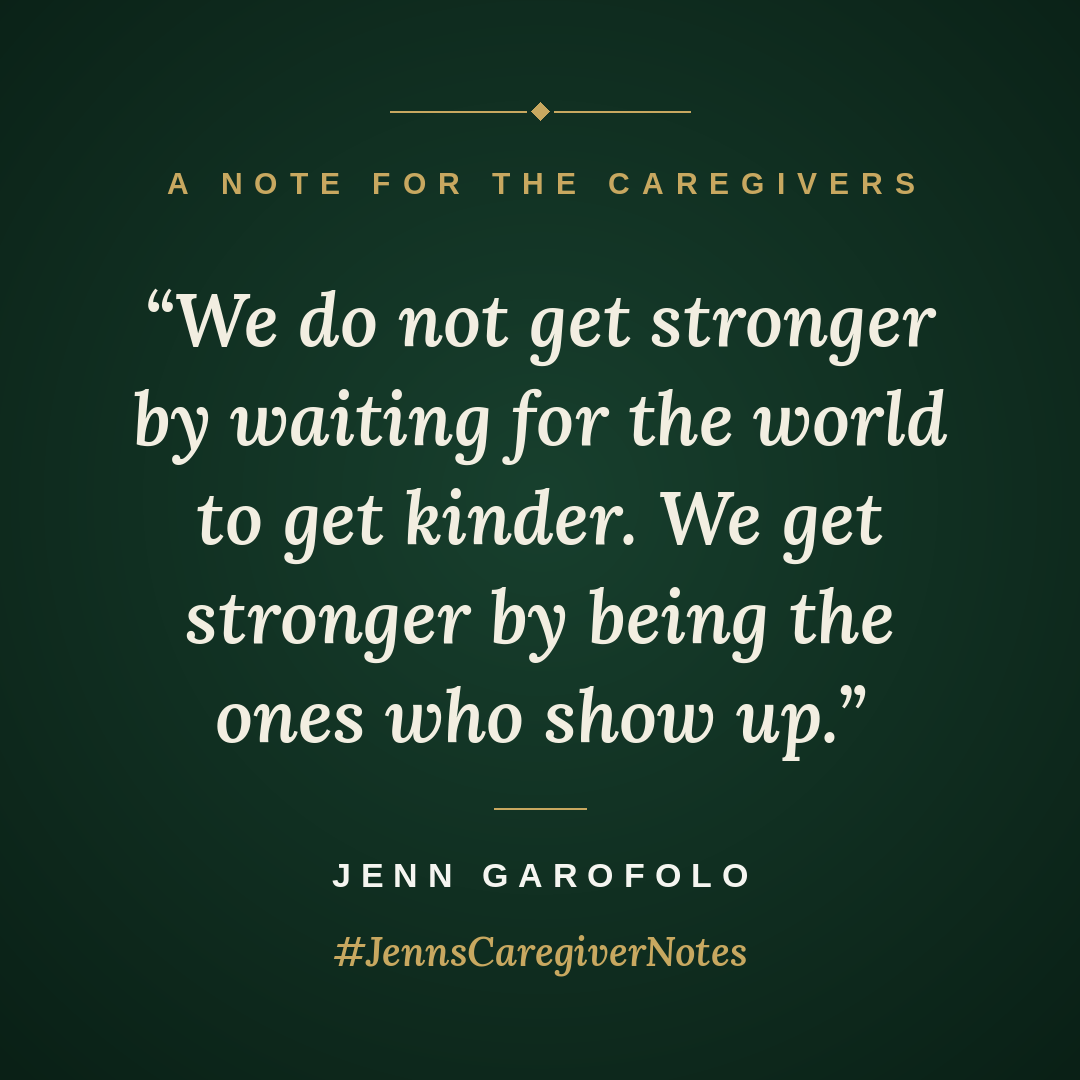
Because that is the whole thing. That is what I learned in hospital rooms and school meetings, and what I relearned on a stranger's front lawn this week. We do not get stronger by waiting for the world to get kinder. We get stronger by being the ones who show up.
I will keep doing what is mine to do. I will be the loud one in the room. I will stand up for the people who are different, the ones carrying things you cannot see. And I am leaving the light on.
Jenn 💚
Get new essays in your inbox.
New posts, book news, and updates, delivered to your inbox.